
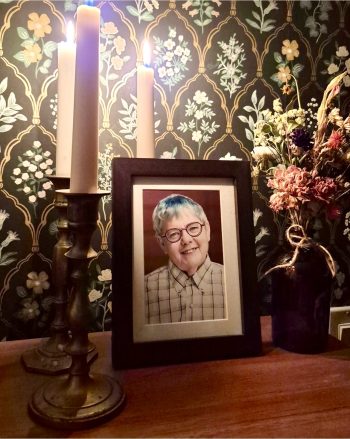
Remembering barbara findlay, KC
We are heartbroken by the passing of barbara findlay KC, our dear friend, colleague, mentor, founding member and kindred spirit. We are profoundly grateful for her mentorship, her generosity, her courage, her brilliance, and her endless work for equality. Fertility Law BC (FLBC) would not be what it is without her. As one of the founding members of FLBC, barbara had a strong vision and commitment to changing fertility law to include all people; all families; all children. Fertility law in British Columbia and Canada has been fundamentally transformed by barbara’s legal advocacy and activism.
FLBC is a small ad hoc group of fertility lawyers. We came together in our joint belief that fertility law should recognize people as they truly are, honour the many ways families are created, and treat everyone involved in family-making with dignity and care. We hold those values in large part because of barbara’s vision and trailblazing work assisting queer and trans families in securing legal rights to parentage, guardianship, relationships and marriage.
barbara was a powerhouse. She was one of our heroes and one of the most important voices in the development of fertility law in British Columbia and Canada. Long before the law recognized queer and trans people and their families, barbara was fighting to make queer and trans lives visible and heard. She worked tirelessly for queer and trans communities, trans children, gender equality, and the right of every person to be recognized for who they are.
For barbara, equality was never merely an abstract legal principle. It was about people’s actual lives: their relationships, their love, their children, and their families. Her work helped make it possible for queer people to marry, to become legally recognized parents, and to see their families reflected in the law. Some of us know, very personally, that our own families have the legal recognition they do today because of barbara.
barbara was endlessly generous with her knowledge, experience, and time. She mentored us, inspired us, challenged us, and changed how we practise law. She taught us that it was not enough for people simply to understand their legal agreement but that they needed to see themselves in their agreements.
As barbara taught us: when you see yourself in an agreement, you see yourself in the law.
If people are not named—if their stories, lived experiences, intentions, relationships, love, and babies are absent from the law—they can be ignored or erased – left vulnerable and at risk. Rights gained can easily be rolled back. barbara wanted every person to be able to look at the law and say: “I exist. I should have legal rights and protections.”
That principle shaped Fertility Law BC from its earliest days. barbara brought us together and pushed us to reconsider how fertility agreements were written. She insisted that we use plain language, real names, and words the people signing the agreements could understand. She reminded us that the people involved in assisted reproduction are not opponents or abstract legal parties. They are human beings cooperating in the profoundly personal and hopeful work of making a family.
Because of barbara, fertility agreements in British Columbia (and beyond) developed with a spirit of humanity and gratitude—a respect for intended parents, surrogates, donors, and, always, the children at the heart of the process. The agreements we use today have evolved, but barbara’s influence remains unmistakable. They are kinder, gentler, and more human because of her.
barbara also taught us not to accept the limits of the law unquestioningly. The prescribed forms, established procedures, and conventional categories were often designed for “Norm,” as barbara would say—not for the real diversity of people, relationships, and families.
If the usual process did not work for the people involved, barbara changed the process. If the form did not contain the right box, she created another one. If the law did not yet provide the protection people needed, she found a way to build it.
She understood that agreements could do more than record the law: they could help create it.
barbara was boldly creative, but she was also, as we recalled together, a “lawyer’s lawyer.” She knew the legal rules and the rules of evidence inside and out. Many of us can still hear her asking: “What is the evidence? How are you going to challenge it?”. She taught us that we must know the legal tools so that we can dismantle the structures that exclude people, create something better, and challenge the law to change.
barbara also had a profound love for children. She taught us to listen to children, to honour their voices, and to recognize that it is not for anyone else to tell a young person who they are. A child should not have to depend entirely upon an adult to defend the child’s right to be themselves. That lesson continues to shape our work, particularly our advocacy for trans children and youth.
barbara’s influence reaches far beyond any one case, statute, or legal victory. It lives in queer and trans people whose identities are recognized, in parents whose names appear on their children’s birth certificates, and in children whose families are protected by law. It lives in every lawyer she mentored, every assumption she challenged, every agreement she made more human, and every door she pushed open for those who followed.
It lives in us.
Even now, if we find ourselves creating an agreement for a family the law did not contemplate, or refusing to be constrained by an inadequate form, or finding a more humane way forward, we might say to one another, “What would barbara do?”. We know the answer would be grounded in justice, equality, and the dismantling of systemic oppressions. It would demand that we ask more of the law and do more for our clients and communities.
There could be no better legacy.
We miss her enormously. We will honour her by continuing the work she taught us to do: making the law work for ALL of us not just some of us.
We send our care and wishes to barbara’s partner Sheila and to barbara’s friends, family and community.
With immense gratitude and respect,
Fertility Law BC
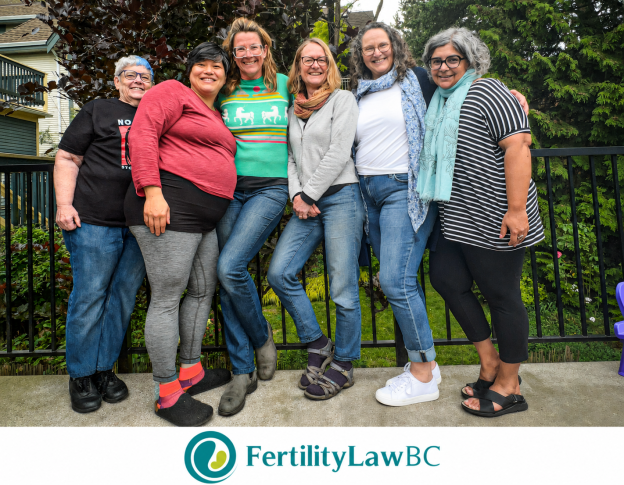
Michelle, Monique, Catherine, Lynda and Zara
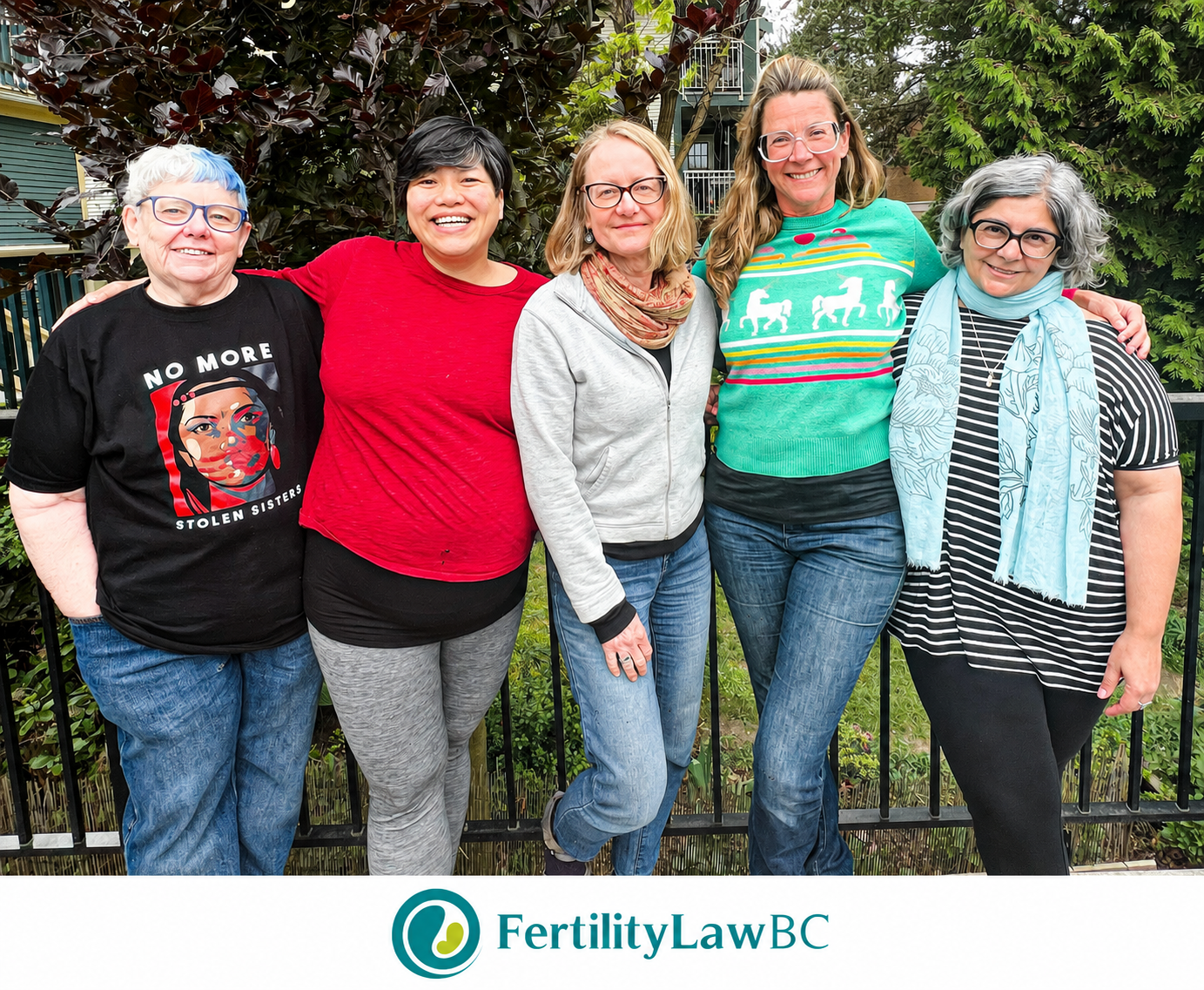
Fertility Law BC- barbara, Catherine, Lynda, Michelle and Zara


